Thursday, July 9, 2009

From Seafloor to Shank Lab: an odyssey of ATC and G

07/09/09

My friends and family often wonder what it is I actually do everyday. Lab work is very much a black box for people who have never been inside a lab or been privy to a friend’s lab tales.

How is it that we’re able to take an animal off the seafloor and eventually end up with genetic sequences that help us understand how that animal evolved and how it’s related to other animals in other ocean habitats?

I’m going to attempt to give you a bit of insight into how gene sequencing works and why it’s important. Hopefully you’ll find this interesting. I’ve inserted some hypertext links to wikipedia sites if you want to read more about a specific term or concept.

The Samples

If you’ve read my previous entries, you know that I was recently on a research cruise to the Mariana Trench. On that cruise, we pulled up several biological specimens from the bottom of the ocean using HROV Nereus.

When you get an animal on the research vessel’s deck, you want to preserve or freeze it as fast as possible. Sometimes, if it’s in a shell or a tube (for example a clam or a tube worm), we will dissect it out of it’s shell/tube in order to get the most amount of tissue exposed. This helps with preservation in alcohol because it means that more alcohol can reach more tissue right away, saturating all the cells and preserving them. We also want to expose the most tissue for frozen samples because that way we have more to work with when we take a piece off for DNA extraction.

Here's a picture of me dissecting out a specimen on the cruise:

Often times, the animals that scientists collect while at sea don’t immediately get back to the lab. In the case of the Nereus samples, they stayed on the ship until it came into port in Hawaii and then were sent over-night in a cooler to Woods Hole.

Building Blocks (ATCG)


For those of you who haven’t thought about DNA since high school biology, I’ll give a very brief description how it is structured. Basically, DNA consists of two long chains of genetic building blocks called nucleotides lined up next to each other. There are 4 kinds of nucleotides in DNA: adenine, thymine, cytosine, and guanine, also known as A,T,C, and G. Each one is a little different from the others and they form specific pairs that we call base pairs. Meaning that A only likes being across from T and C only likes being across from G.


In all of your cells, DNA lives in the nucleus, a well-protected compartment that keeps all 3 billion of your base pairs organized and accessible to the cellular machinery!!

An animal cell (nucleus labeled), from a website I found on google images:


DNA extraction

There are many different methods used to extract DNA. They all have a few things in common, however. First of all, you have to essentially destroy the cells in the sample in order to free the DNA from the cell’s nucleus. As you might imagine, DNA is pretty well protected by the cell. Using chemicals and enzymes, usually mixed with heat and some physical agitation, the first step of any extraction is to free the DNA by digesting the cell around it. You have to disrupt the cell membrane and try to digest proteins in the cell.

What does that mean for me? It means that my first step in a reaction is to put a very small piece of the animal’s tissue in a tube with a specific set of reagents that break up cells. Then, I leave that tube in a warm water bath for a while (usually overnight) to help the reaction go faster.

These are the water baths in our lab:


The next day, I go through a number of steps to isolate the DNA chemically from the other fragments of the exploded cell. Since DNA has a specific structure and is made of certain molecules, it has specific chemical properties that we can exploit to isolate it from other molecules. Each of the different extraction methods exploits these properties in different ways but in the end, you should end up with somewhat pure DNA.

Once you have separated the DNA from other cell parts, you put it through a series of reactions that makes many copies of one specific gene. Essentially, you selectively copy the gene you want to study by using enzymes that link nucleotides together in the same way that enzymes copy DNA inside a live cell. This process is called a polymerase chain reaction, or PCR.

Gene Sequencing

After we’ve made many copies of the one gene we want, we run a sequencing reaction. A sequencing reaction is somewhat similar to PCR with a really amazing twist. In PCR, you add a mixture of nucleotide bases for the enzymes to use as building blocks. In a sequencing reaction, some of those nucleotides force the termination of the DNA strand because they are chemically different from normal nucleotides and don’t allow other nucleotides to latch onto them. These special building blocks are also labeled, or tagged with molecules that glow specific colors under certain conditions.

Since you are essentially making copies of the many PCR-formed copies of your desired gene, and you are using these special nucleotides that stop, you theoretically end up with many different lengths of DNA strands—from one nucleotide to the whole length of the gene in question. (Meaning, you’ll have a mix of the following: A, AT, ATT, ATTG, ATTGC, ATTGCC, ATTTGCC, etc.) Statistically, the nucleotide mix is meant to have enough of each type of nucleotide for this to work.

There’s a really incredible machine that can read these glowing sequences. It goes through and says, “This fragment is 5 nucleotides long and the last one glows red, so we know that the fifth nucleotide is a thymine.” A computer listens to the machine and stores this info. We get the sequence back and can then use software to read it to (first) see if everything worked, and (second) use the sequence to find out interesting things about the animal.

The data comes back to us not only in text files, but also with what’s called a chromatogram that shows how strong each color signal was and if there were conflicting color signals.

A chromatogram looks like this (the top row of this looks like a pretty good sequence; I pulled this off a google images):


What we do with the sequence could take up another really long blog post. So I will refrain from telling you all about that until a later date.

Until next time,
E
llie

Friday, July 3, 2009

Fourth Of July in the Hole


I’d love to give you the impression that all we do is work day and night, completely engrossed in the perpetual search for scientific breakthroughs and the subsequent enlightenment that is sure to follow. Unfortunately, I feel obligated to tell you that we do other fun things, too.

This weekend is a perfect opportunity to sit back, relax, and enjoy the cape. We had the day off from work today (Friday), making it a three-day weekend.

Here are just a few of the things that I’ve been doing and plan to do during this weekend:

Ladies Racing at the Yacht Club

While I was on the Nereus cruise, I had time to chat with my shipmates about what they do on cape during the summer. One of these conversations led to my discovery of ladies racing night at the yacht club. I wouldn’t call myself an extremely experienced sailor, but I would say that I’m an avid sailing enthusiast who would like to be on the water more than I have been over the last five years.


(Cape Cod Knockabouts. Image from flickr.)

One of the other women on the cruise had a friend—also a WHOI employee—who was looking for crew for ladies night. I, being a lady, deemed myself qualified and contacted her once in town.

Last night was the first official race of the season. It was raining hard all day but it cleared up and the sun shone down on Woods Hole for the race. We had a lovely sail and I had a fabulous time. I know you all want to know, so I’ll just go ahead and tell you: we won (which was nice). Still, the part that really mattered was that I had a fun Cape Cod experience in the afternoon sun.

(Above: WH Yacht Club)

Friday Night Lectures

I know I said that I was taking this extended weekend to sit back and relax, so you might wonder why this section’s subheading contains the word “lecture.”

The Marine Biology Laboratory of Woods Hole (MBL) hosts a lecture series in the summer. Each Friday, they have a speaker come and give about an hour-long talk about a variety of biological and/or ocean-related topics. Dr. Susan Avery—the director of WHOI—is giving tonight’s talk. It’s titled “Coastal Cities, Coastal Impacts: The Tides They Are A-Changin.” I’m very excited to hear the talk because I feel that issues surrounding human impacts on the coast and the impacts of climate change on coastal living are pertinent to my life. In fact, such issues are pertinent to all our lives since the majority of the world’s cities are coastal.

The Friday lectures are free and generally accessible to audiences with little or no background knowledge. To learn more about the MBL lecture series, check out the Friday Evening Lecture Series Website. They even have podcasts of the talks so you can listen in wherever you are!

The Barn Olympics


The Barn Olympics is a holy event. Okay, fine—that might be hyperbole. But it is really fun.

Each summer a group of WHOI graduate students plan the Olympics for Summer Fellows, Joint Program Students (the grad program that WHOI has with MIT), MBL students, Sea Education Association affiliates… basically anyone who is around the Hole in the summer and somehow engaged in marine science. Last year it was predominantly WHOI kids, though.

Participants form teams of 4 (preferably 2 women and 2 men) and compete in a series of partly serious/mostly ridiculous games and competitive events. The events last summer included a photo scavenger hunt, an abbreviated triathlon, tug-of-war, trivia, dodge ball…the list goes on. Each team has a theme and dresses up. There are, of course, prizes for best costumes, best team name, etc. Our team is called “The interweb,” and we’re in the process of designing some winning costumes.

The Olympics are this Sunday. I’ll be sure to let you know how they go!

I hope you didn’t mind reading about my goofy weekend plans.

Stay tuned for my next entry—“From Seafloor to Shank Lab: an odyssey of ATC and G”… I’ll attempt to keep you entertained while explaining some pretty sciencey things.

Happy Fourth of July! Have a fun and safe weekend!

-Ellie

Monday, June 29, 2009

Open Water

In April, my friend mailed me a dried four-leaf clover. I damaged the fragile specimen while opening his letter and thought I was in for a streak of bad luck.

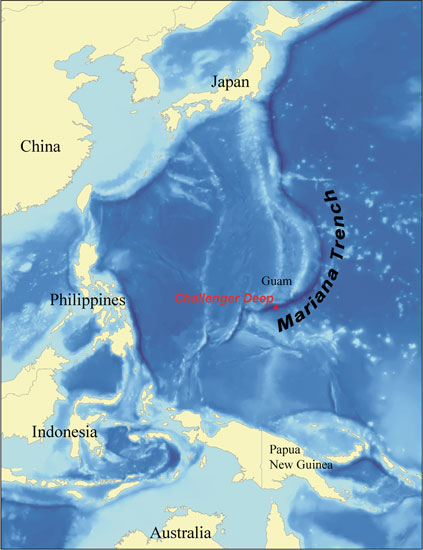
The luck charm must have still worked, however, because not long thereafter I got an e-mail from Dr. Shank asking me to accompany him on a research cruise to the Challenger Deep in the Mariana Trench (the deepest point in the ocean)! The trip included about two weeks at sea, three weeks total travel time. We left from Guam. Wow.

Where is the trench, anyway?

From www.whoi.edu

A Science Cruise

When scientists talk about cruises, it’s really hard to imagine what they are talking about. Many people come up with images of Carnival Cruise Lines, pool boys, and drinks adorned with little umbrellas. Around the lab, when you say “I’m going on a cruise,” different images come to mind.

For me, a cruise means really cool science. I’ve always wanted to go on a cruise. I think of deep submersibles traveling to the ocean’s depths and bringing back presents for us scientists—be they water samples, rocks or mud, or as is the case for me and my fellow biologists, little critters that we would never see or touch were it not for the technology that takes us out to sea.

For many who do coastal work, getting samples is relatively straightforward, at least as far as geography goes. For those of us who work on deep-sea habitats like hydrothermal vents (basically hot springs at the bottom of the ocean) or seamounts (similar to mountains or volcanoes on land, only underwater), it’s really hard to get animals to study. That’s where the technology comes in.

In addition to the work and the science, you still get the amazing vistas that you might imagine on any type of cruise.

Sunrise at Sea:


Sunset at Sea:


HROV Nereus

This particular cruise was the final test cruise for WHOI’s new deep submersible Nereus, which is a Hybrid Remotely Operated Vehicle (HROV). That means that it can be either a remotely operated vehicle (ROV)—tethered to the ship and controlled by a team in real-time—or an Autonomous Underwater Vehicle (AUV). AUVs are preprogrammed with a mission and sent out to complete that mission free from human contact until retrieved and the data collected. Nereus wears both hats, which is why we call it a hybrid.

I witnessed the culmination of many years of work on the part of an all-star engineering and design team from WHOI and Johns Hopkins University. Because of these masterminds, US scientists now have the ability to work at the deepest parts of the ocean. I am extremely lucky to have been on such a historic cruise and was perpetually awed by the sheer brainpower aboard the ship!

I was part of the science team on the ship (consisting of Dr. Tim Shank and myself from WHOI, and Dr. Patricia Fryer and Sam Hulme from the University of Hawaii) and I helped Tim to preserve and catalog the biological specimens we pulled up with Nereus.

HROV is designed to travel to the deepest regions of the ocean and to withstand pressure too intense for other submersibles. It allows us to stay at depths of approximately 11 km (deeper than Mount Everest is tall) for many hours to explore and collect scientific samples.

For more information about the vehicle, please visit WHOI’s Nereus website. You can also visit the press release for the cruise.

Nereus and me on the back deck:


My Graduation

The only slight hesitation I had when responding to Tim’s invitation was that I’d miss my college graduation. That only detained me for a few minutes because it occurred to me that the life-long dream of going to sea for science research was WAY cooler than staying for commencement. So I said bye to my friends early and headed off to Guam.

The day of my commencement back in Ohio, however, some of the other scientists on the cruise surprised me with a shipboard graduation ceremony. It was extremely sweet and funny and I was truly surprised. Everyone dressed up in “robes” that were really garbage bag capes and mortarboards that were made out of cardboard boxes. The tassels were made out of thick twine. There were mini-speeches and everything!

Firsts

I could go on and on and on about his trip—my first cruise, my first real-time observation of a hydrothermal vent, my first time snorkeling (I know, I know, how had a marine biologist not snorkeled? I’m from Seattle and went to school in Ohio!). I think I was also the first person to have a fake graduation ceremony on the RV Kilo Moana (the University of Hawaii's research ship that took us out to the trench).

This trip won my “most amazing scientific experience ever” prize and is an opportunity that I wouldn’t have had if I hadn’t been in exactly the right place at the right time. The people who work at WHOI's Deep Submergence Lab do incredible work and I am so honored to have been included on this cruise! One of my favorite things about WHOI is the high level of interdisciplinary collaboration and this trip is an excellent example of how scientists work with engineers to explore the ocean and push the boundaries of ocean science.

Neat picture of HROV going into the water:


More to come!
-Ellie

***All photos By Ellie Bors, Woods Hole Oceanographic Institution

Wednesday, June 24, 2009

Introductions


Consider this a prologue:


I was born and raised in Seattle, Washington. While my proximity to the ocean certainly influenced my development and shaped my childhood experiences, I didn’t always know I wanted to be a marine biologist, nor was I always interested in science. Once you’re hooked, though, there’s no going back! In high school I participated in a marine science course at the Sea Education Association (SEA) in Woods Hole. It was more or less an abbreviated version of their semester program—10 days on land in classes and 10 days at sea on the SSV Corwith Cramer, a 134-foot brigantine. Needless to say I had an amazing time.

Since then, I’ve been seeking out marine-related internships and courses. I met Dr. Tim Shank (my advisor here at WHOI) at the March 2008 Ocean Science Meeting in Orlando, FL. I was there to present a poster about research I conducted at the Mount Desert Island Biological Laboratory (MDIBL) through a Research Experience for Undergraduates internship during the summer of 2007.

I’ve been interested in Dr. Shank’s work since I learned about hydrothermal vents in high school (coincidentally while I was in the SEA program) and was nervous to meet him—it’s scary to meet a researcher whose science is so cool that you almost feel unworthy of even meeting them! After collecting my thoughts, I introduced myself at his poster presentation and tried to ask the smartest questions I could muster. I soon learned about the guest student program here and that, even though I’d missed the 2008 Summer Student Fellow (SSF) application deadline, I could still apply to come as a guest student. I e-mailed Tim my resume and he encouraged me to apply. That’s how I ended up at WHOI last summer. I loved it so much that I came back this year as a SSF!

This May I graduated from the double degree program at Oberlin College and the Oberlin Conservatory of Music with a Bachelor of Arts in Biology (minor in politics) and Bachelor of Music in Cello Performance. The SSF program is unique in that you can apply while you’re a senior and come after you graduate, which is not the case with many undergraduate fellowships. I’m taking a year off before graduate school—after 5 years of college I thought I’d benefit from some learning away from the classroom—and a summer at WHOI is a fabulous way to kick off my year of exploration and personal growth.

Whew. With that out the way, I promise never to talk that much about myself again! While the primary goal of this blog is to chronicle my summer in the SSF program, I also hope that future entries will give you a sense of (1) why I think science is so cool and (2) why I think WHOI is so cool.

Until next time,
Ellie